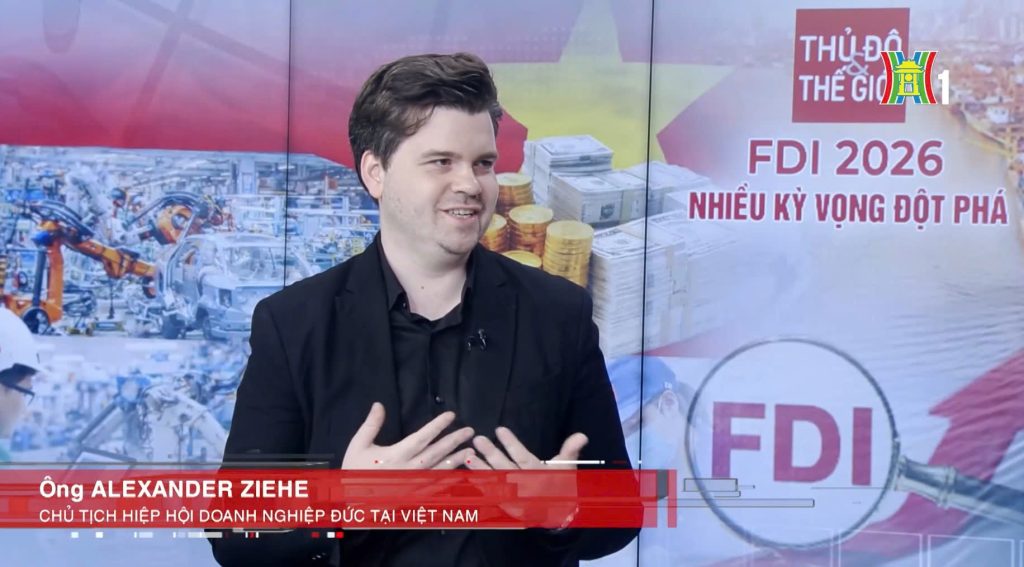
In a recent interview with Hanoi TV, Mr. Alexander Ziehe shared his perspectives on Vietnam’s foreign direct investment (FDI) outlook for 2026, highlighting both the opportunities and the structural shifts shaping the country’s investment landscape.
Click here to explore full interview (in Vietnamese)
When asked about Vietnam’s strong FDI performance in 2025 and the role of government policies, he emphasized that Vietnam has increasingly positioned itself as a “magnet” for foreign investors amid global trade uncertainties. He noted that the country’s openness, combined with a wide range of free trade agreements and a competitive workforce, has created a solid foundation for attracting diverse investment flows. More importantly, recent institutional reforms implemented with speed and strong political commitment have significantly improved investor confidence. Administrative procedures, which have long been a concern for foreign businesses, are now being streamlined, with visible improvements in licensing, taxation processes, and factory setup timelines. These changes are not only reflected in investor sentiment but also in actual investment figures, reinforcing Vietnam’s growth trajectory.
Regarding Vietnam’s strategic shift toward selective, high-quality FDI, Mr. Alexander Ziehe described this direction as both necessary and forward-looking. He explained that Vietnam is no longer aiming to attract investment at all costs but is instead focusing on sectors with high technological content and added value, such as semiconductors, automotive manufacturing, and advanced electronics. However, he stressed that attracting these industries requires more than just policy incentives. A comprehensive industrial ecosystem must be developed to support them. For example, even highly advanced sectors depend on a network of supporting industries, including suppliers of plastic components, metal parts, and other essential materials. Without such an ecosystem, sustainable growth in high-tech industries would be difficult to achieve.
When discussing what high-quality investors, particularly in technology and artificial intelligence, are looking for in Vietnam, he pointed out that while the country’s openness and international integration remain key strengths, the next stage of development will depend heavily on human capital. High-tech industries require a skilled local workforce, and this is an area where stronger collaboration between businesses, educational institutions, and government bodies is essential. He also highlighted the important role of foreign experts, noting that they should not be seen as competitors to local talent but as contributors who bring knowledge, innovation, and global best practices. At the same time, improving the regulatory environment for work permits and visas remains a critical factor in maintaining Vietnam’s attractiveness.
Another key point raised in the interview was the importance of local partnerships. According to Alexander Ziehe, successful FDI projects are often those that are well integrated into the local economy through strong collaboration with domestic companies. Building these partnerships not only supports supply chain development but also enables knowledge transfer and long-term value creation. Organizations such as business associations play a vital role in facilitating these connections and strengthening cooperation between foreign investors and local enterprises.
Looking ahead to 2026, he expressed strong agreement with the view that this could be a breakthrough year for Vietnam’s FDI. He explained that increasing clarity in global trade policies, along with Vietnam’s expanding integration into markets such as Europe, the Middle East, and other parts of Asia, provides a more stable environment for investors. Beyond export-driven growth, he highlighted the rising importance of Vietnam’s domestic market as a key driver for future investment. In addition, the growing openness of large Vietnamese corporations to collaborate with international partners is creating new opportunities for foreign businesses to enter and expand within the market.
In conclusion, Alexander Ziehe underscored that Vietnam is entering a new era defined not only by growth but by quality, innovation, and sustainability. With continued reforms, stronger public-private collaboration, and a focus on building a complete industrial ecosystem, Vietnam is well positioned to attract the next generation of high-quality FDI. If these efforts are sustained, 2026 may indeed mark a pivotal moment in the country’s journey toward becoming a leading investment destination in the region.